
Rocket MortgageClient MarketingScrum@Scale Transformation
Rocket Mortgage Reduced Cycle Time by 86% and Increased Feature Delivery by 721% with Scrum@Scale
Rocket Mortgage had already made significant progress scaling Agile across their organization. But their Client Marketing group believed there was another level of performance within reach.Working with Scrum Inc. and co-founder Dr. Jeff Sutherland, Client Marketing built on that foundation with Scrum@Scale, strengthening Scrum across teams while addressing barriers in communication, testing, infrastructure, deployment, and DevOps. Their goal: reduce cycle time, improve quality, and give teams greater autonomy to deliver.
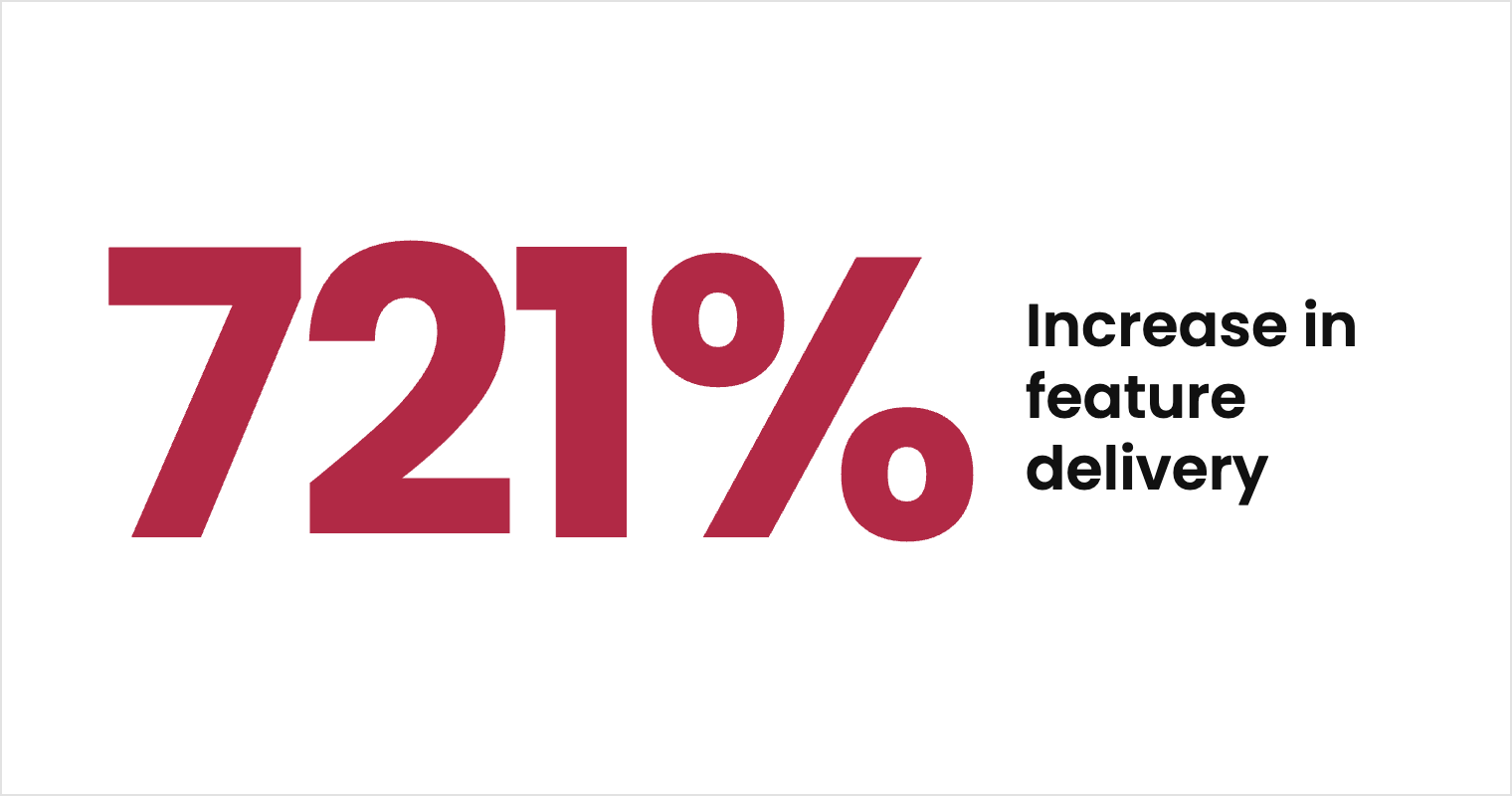
The results, published in the following peer-reviewed IEEE white paper, speak for themselves: Average feature cycle time fell 86%, from 83.7 days to 11.6 days, while feature delivery increased 721% with higher quality.

Results at a glance
86%
Shorter average feature cycle time
721%
Increase in feature delivery
3×
Improvement in feature predictability
91%
Increase in commitment completion
Finding the next level of performance
Rocket Mortgage's initial Agile transformation reorganized teams around business value streams, creating greater alignment while preserving team autonomy. And it was already producing results: company-wide feature cycle time fell from 71 to 33 days, feature throughput increased 101%, and planned work completed rose from 60% to 88%.
But for Client Marketing, those gains weren't enough. Responsible for the client-facing front end of Rocket Mortgage's mortgage system, their teams faced constant demand for new functionality and a better user experience. Leadership saw an opportunity to go further with Scrum@Scale, identifying four areas for improvement:
But for Client Marketing, those gains weren't enough. Responsible for the client-facing front end of Rocket Mortgage's mortgage system, their teams faced constant demand for new functionality and a better user experience. Leadership saw an opportunity to go further with Scrum@Scale, identifying four areas for improvement:
01
Create greater consistency in Scrum practices.
Roughly half of Client Marketing's Scrum teams had significantly altered four of five Scrum events, and Scrum roles were not applied consistently. Only one-third held Daily Scrums, Sprint Planning, and Sprint Retrospectives or had a Definition of Ready. None had a Definition of Done.
02
Reduce specialization and focus more roles on delivery.
Client Marketing had accumulated specialized roles that created additional handoffs and communication overhead. The group wanted more of the skills required to deliver working software within each team.
03
Make communication across teams more productive.
Priorities and outcomes were spread across separate meetings, while the daily leadership standup focused on schedules and status updates rather than the impediments preventing teams from delivering.
04
Reduce cycle time even further.
Client Marketing's average feature cycle time was 83.7 days. Deployments typically happened only once every two weeks, required an external team, occurred late at night because of downtime, and could take two to three hours. Testing and infrastructure dependencies created additional delays.
How They Got There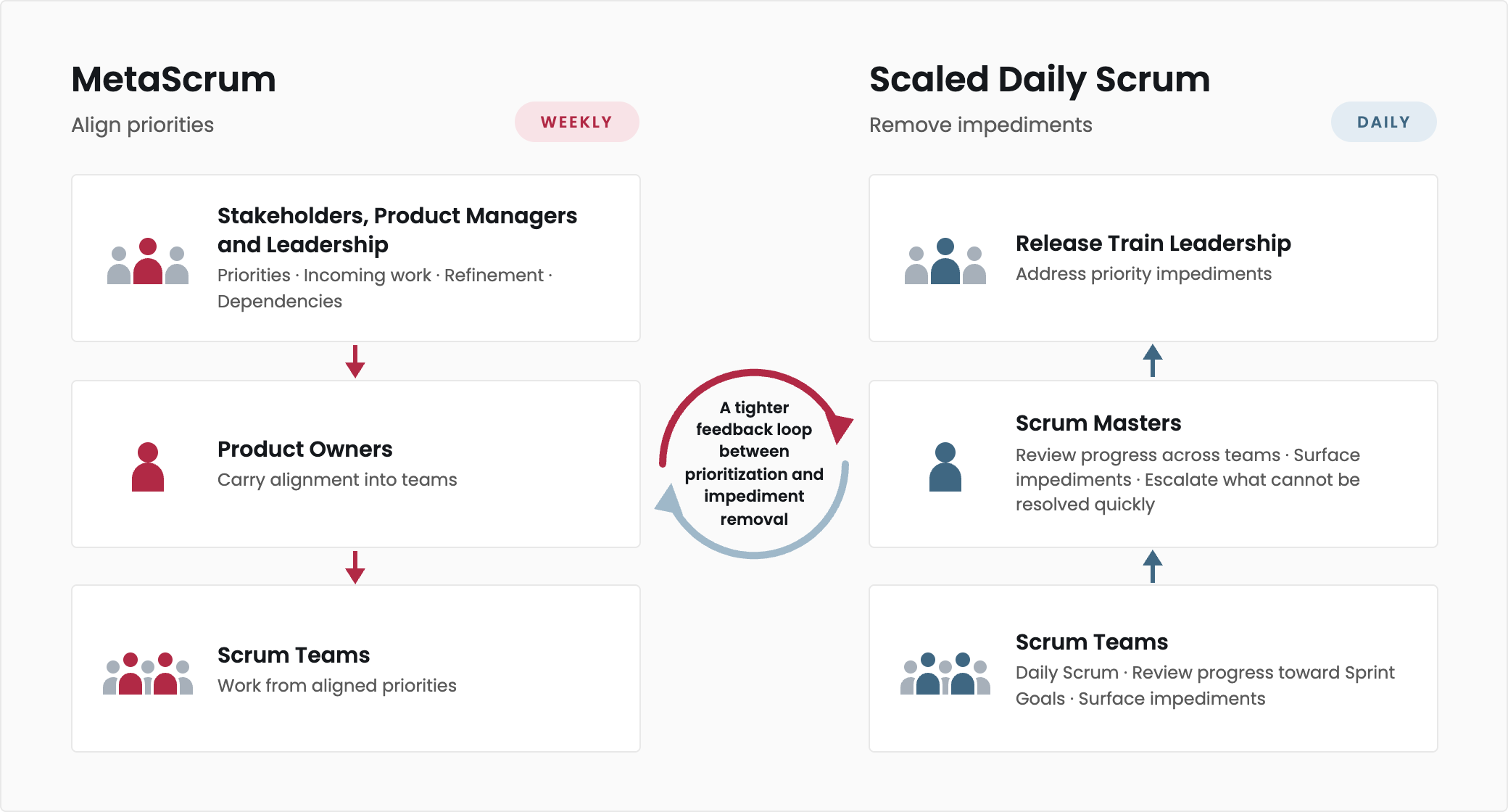
Strengthening Scrum across teams
Client Marketing began by creating greater consistency across the release train. Senior leadership trained with Dr. Jeff Sutherland on scaling Scrum, teams were retrained on Scrum's roles, events, and artifacts, and the group conducted a "hard reset" to remove practices that had accumulated over time.
After the reset, teams followed the Scrum events defined in the Scrum Guide, established Definitions of Ready and Done, and clarified Product Owner and Scrum Master responsibilities. Client Marketing's leadership also began operating as a Scrum team.
Two Scrum@Scale practices connected that work across teams. Together, the two created a tighter feedback loop between what teams should work on and what was preventing them from delivering it.
After the reset, teams followed the Scrum events defined in the Scrum Guide, established Definitions of Ready and Done, and clarified Product Owner and Scrum Master responsibilities. Client Marketing's leadership also began operating as a Scrum team.
Two Scrum@Scale practices connected that work across teams. Together, the two created a tighter feedback loop between what teams should work on and what was preventing them from delivering it.
MetaScrum aligned priorities.
A weekly MetaScrum brought stakeholders, Product Managers, and leaders together to coordinate priorities, incoming work, refinement, and dependencies, with Product Owners carrying that alignment into their teams.
The Scaled Daily Scrum removed impediments.
Scrum Masters met after their teams' Daily Scrums to review progress toward Sprint Goals and surface impediments. If a problem couldn't be resolved quickly within the team, it became a priority for release train leadership.
Fewer Handoffs
Removing the bottlenecks between teams and delivery
Client Marketing also reduced the handoffs surrounding delivery. Specialized roles were broadened so more work could happen within each team, while unit, accessibility, and regression testing were automated and quality gates helped maintain standards.
Deployment moved from manual releases involving an external team every two weeks to an on-demand CI/CD pipeline with containerized infrastructure and automated deployment. Teams gained more direct control over testing and deployment, with fewer dependencies between writing code and getting it into production.
Deployment moved from manual releases involving an external team every two weeks to an on-demand CI/CD pipeline with containerized infrastructure and automated deployment. Teams gained more direct control over testing and deployment, with fewer dependencies between writing code and getting it into production.
Planning became more continuous too, moving from quarterly release planning to monthly and eventually to continuous planning, further reducing the time between identifying valuable work and getting it to clients.
The Results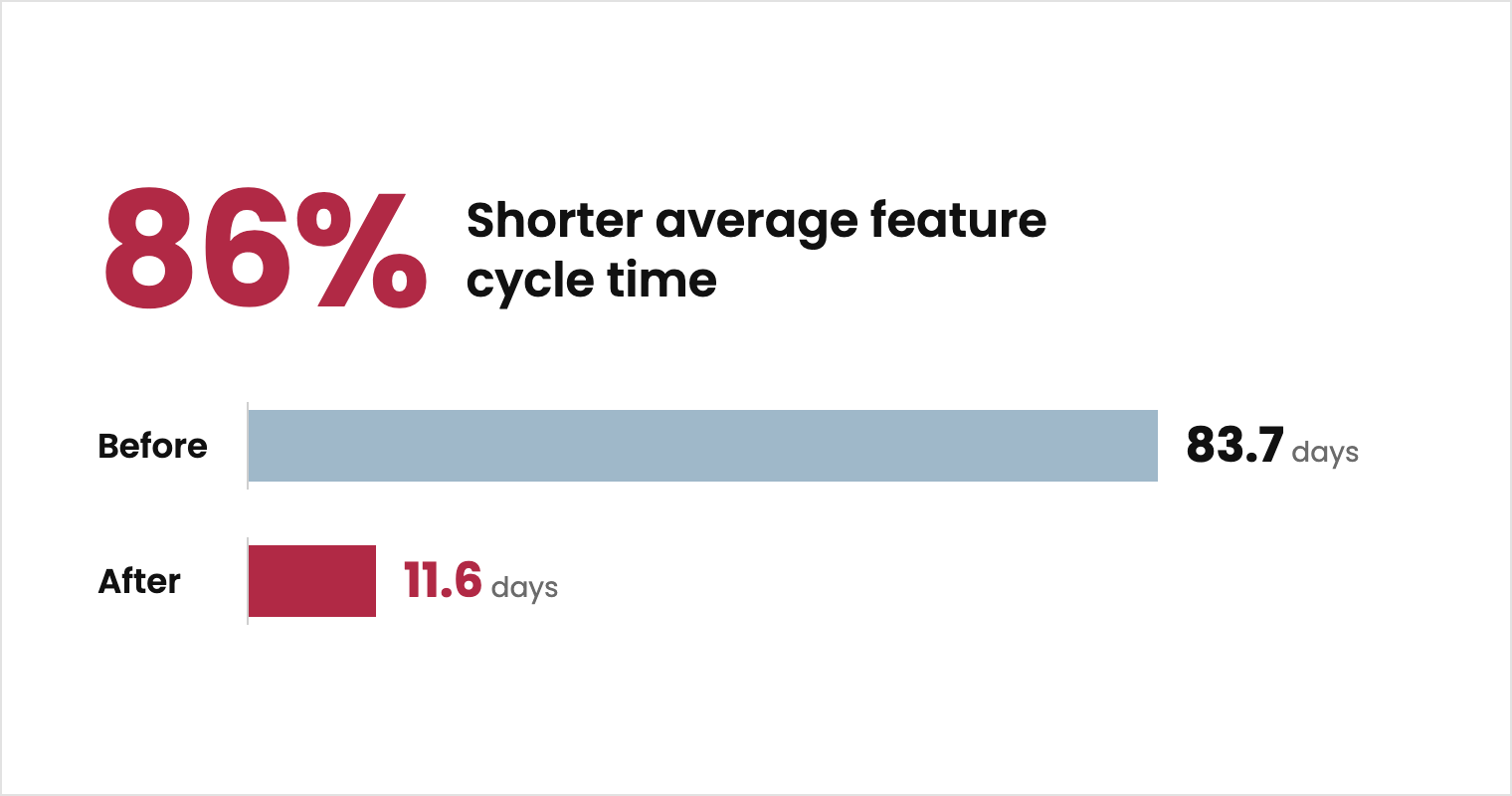

Faster delivery, greater predictability
Client Marketing's Scrum transformation produced significant improvements in both the speed and consistency of delivery. Variation in feature cycle time fell from 46 days to 14 days, a threefold improvement in predictability, while commitment completion increased 91%.
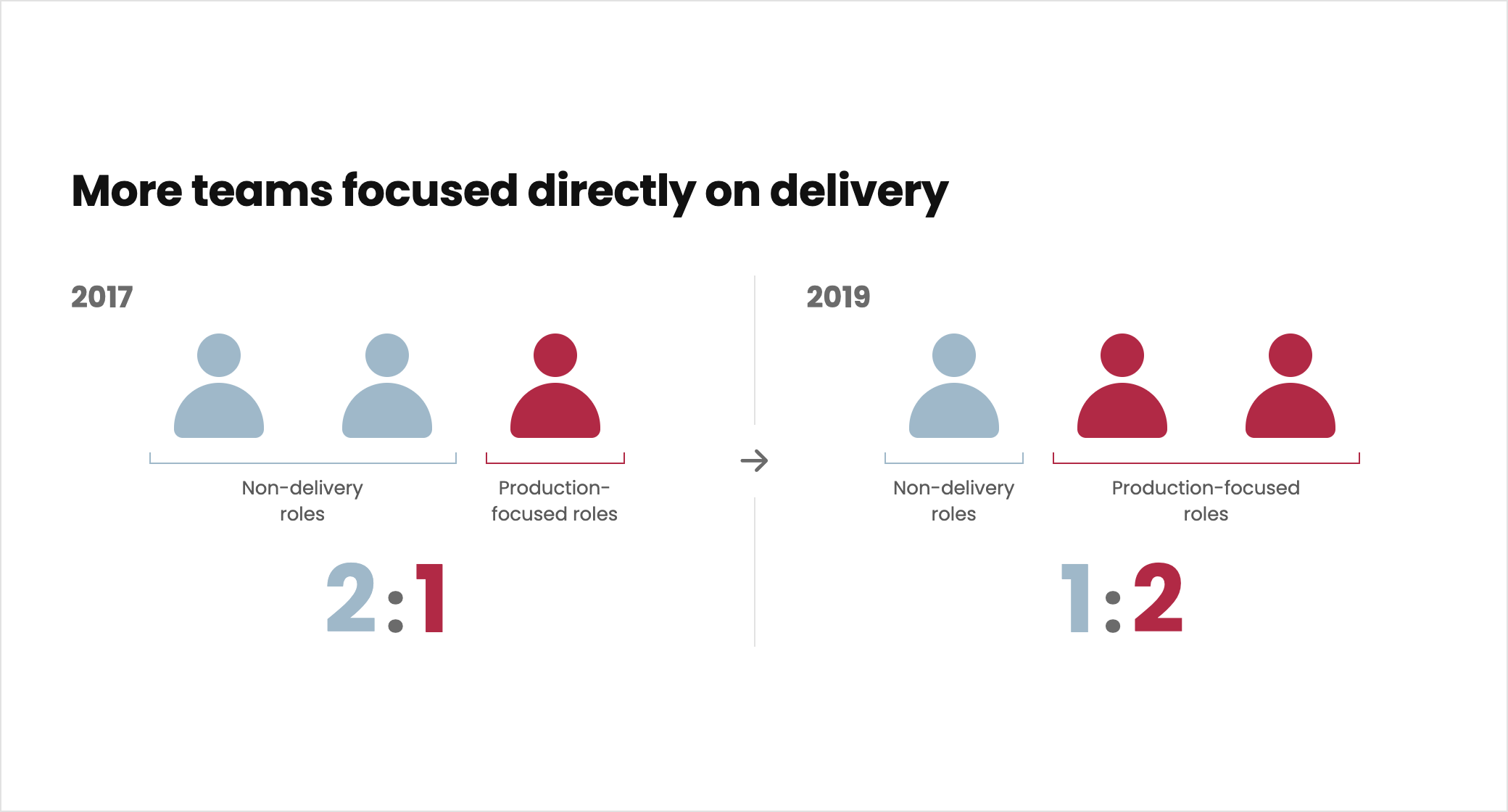
The makeup of Client Marketing changed alongside their delivery system. In 2017, the group had roughly two non-delivery roles for every production-focused role. By 2019, that ratio had reversed to approximately one non-delivery role for every two production-focused roles.
Teams also gained greater control over getting work into production. Automated testing replaced several manual testing activities, on-demand deployment replaced the previous two-week cadence, and containerized infrastructure reduced reliance on an external infrastructure team.
The makeup of Client Marketing changed alongside their delivery system. In 2017, the group had roughly two non-delivery roles for every production-focused role. By 2019, that ratio had reversed to approximately one non-delivery role for every two production-focused roles.
Teams also gained greater control over getting work into production. Automated testing replaced several manual testing activities, on-demand deployment replaced the previous two-week cadence, and containerized infrastructure reduced reliance on an external infrastructure team.
The Takeaway
Building on what was already working
Rocket Mortgage didn't need to start their Agile transformation over. Client Marketing built on an existing foundation and went further with Scrum@Scale.
By strengthening Scrum across teams, aligning priorities through MetaScrum, escalating impediments through the Scaled Daily Scrum, and removing technical dependencies around testing and deployment, Client Marketing created a faster, more predictable path from priority to production.
By strengthening Scrum across teams, aligning priorities through MetaScrum, escalating impediments through the Scaled Daily Scrum, and removing technical dependencies around testing and deployment, Client Marketing created a faster, more predictable path from priority to production.
The result was an 86% reduction in average feature cycle time and a 721% increase in feature delivery, while giving teams greater control over how work moved from development into the hands of clients.
Learn more about the transformation
This case study highlights the key changes and outcomes from Rocket Mortgage's Client Marketing Release Train. The peer-reviewed IEEE white paper, "Rocket Mortgage Delivers Twice the Value at Half the Cost at Scale," provides the complete research methodology, analysis, implementation details, and supporting data.
Ready to improve how your
organization turns priorities into results?
Figures as reported in the IEEE white paper "Rocket Mortgage Delivers Twice the Value at Half the Cost at Scale."