
This brief examines the Customer Centricity dimension and how it compares to the other four agile dimensions and identifies organizational trends, perception differences between leaders and teams, patterns, and leadership implications.
Business agility is an organization's ability to adapt to changing customer needs and market conditions while continuing to deliver value. Customer Centricity is fundamental to achieving this agility because organizations cannot adapt effectively unless they can identify changing customer needs, translate those signals into priorities, and respond through their products and services.
What Is Customer Centricity, and Why Does It Matter to Agility?
A customer-centric organization does more than express a commitment to its customers. It builds customer and market feedback into the way work is prioritized, developed, and improved. Customer Centricity refers to an organization's ability to identify changing customer needs and deliver the right solutions at the right time.
The customer may be external or internal. In either case, keeping the customer top-of-mind in action, not just words, allows an organization to distinguish itself and create real value.
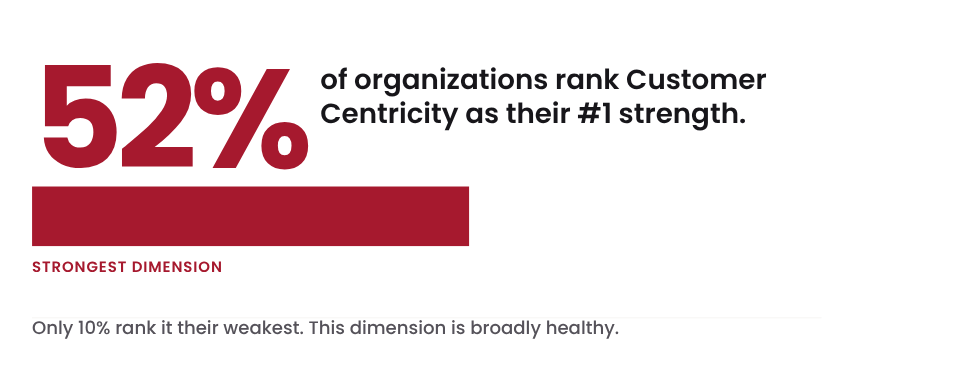
Customer Centricity is the most frequently reported organizational strength—but only 52 percent of organizations rank it first. More importantly, that apparent strength masks a significant vulnerability: organizations appear better at responding to customer needs they already understand than at detecting emerging needs and converting customer and market signals into prioritized work.
Market Feedback, which measures an organization’s ability to capture and act on signals customers do not explicitly articulate, ranks 14th of 19. This suggests that organizations may understand some customer needs but struggle to respond to less explicit signals and translate what they learn into priorities and action.
In other words, organizations tend to respond to customer signals after they become clear rather than detecting them early. Customer Satisfaction is a lagging indicator. Market signal capture is the leading one, and it is the part of this dimension that consistently underperforms.
What Are the Three Customer Centricity Sub-Dimensions?
To truly understand how an organization enables Customer Centricity, we look at three sub-dimensions:
- Customer Satisfaction – Is there a defined practice or process for gathering customer satisfaction on a set cadence? Is customer feedback measured, analyzed, and acted upon?
- Solution Innovation – Are customer solutions and products tailored or adapted to meet evolving customer needs? Is innovation built into solution and product development?
- Market Feedback – Does the organization have a repeatable system for gathering, interpreting, and acting on timely customer and market feedback? Do those signals change priorities, decisions, and what gets built?
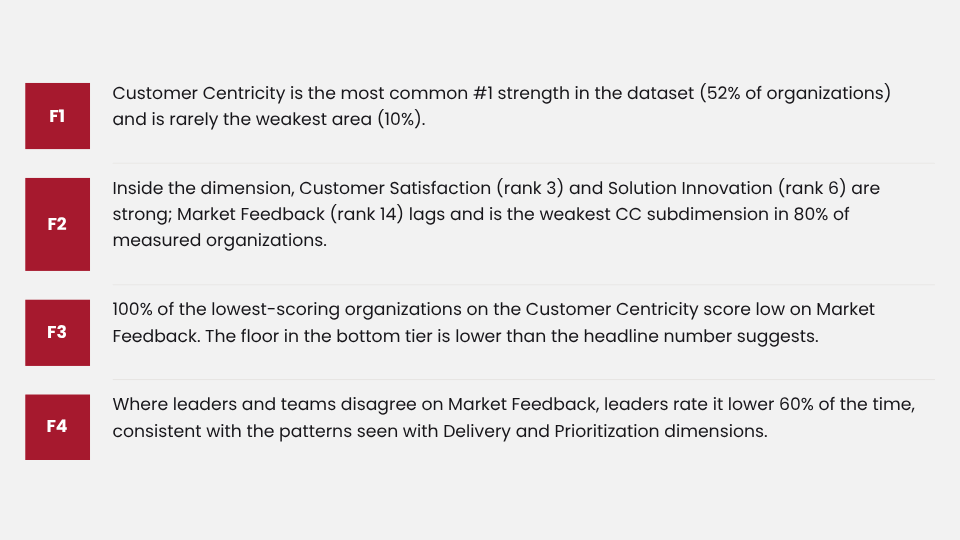
Eighty percent of organizations rank Market Feedback as their lowest sub-dimension within Customer Centricity. Among organizations that had Customer Centricity as their lowest overall dimension, 100 percent scored worst on Market Feedback. For organizations struggling with how to center their customers’ needs, gathering market feedback can be a clear initial area for improvement.
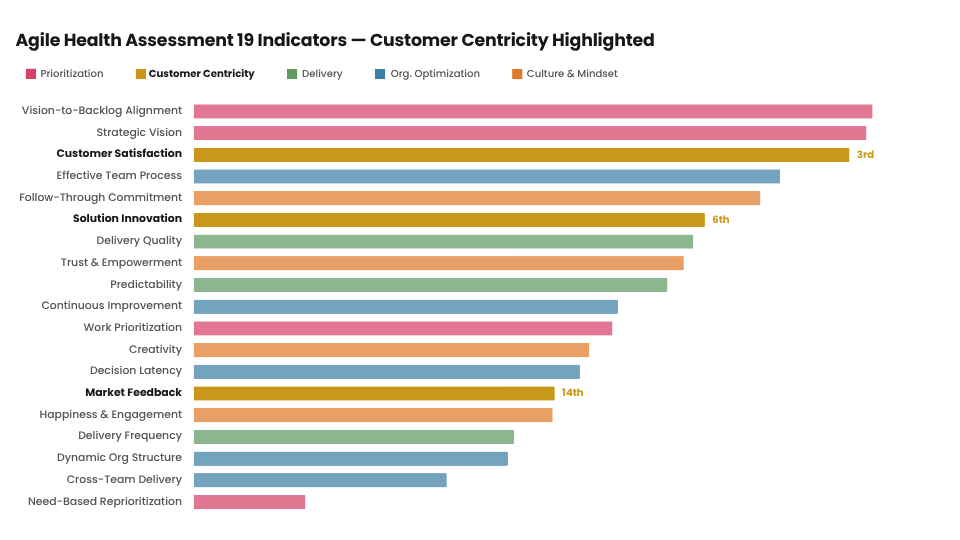
The rankings reveal a gap between customer focus and the ability to act on customer evidence. Customer Satisfaction ranks 3rd of 19 indicators and Solution Innovation ranks 6th, while Market Feedback falls to 14th. This 11-position gap may create a false signal: organizations can appear customer-centric because they respond well to known needs, even when they struggle to detect change and translate market feedback into adjusted priorities, decisions, and work.
For organizations struggling with how to center their customers’ needs, gathering market feedback can be a clear initial area for improvement.
How Leaders and Teams Perceive Customer Centricity Differently?
Across our data set, 45 percent of organizations show meaningful misalignment between leaders and teams. Among those organizations, 60 percent have leaders rating Market Feedback lower than their teams do.
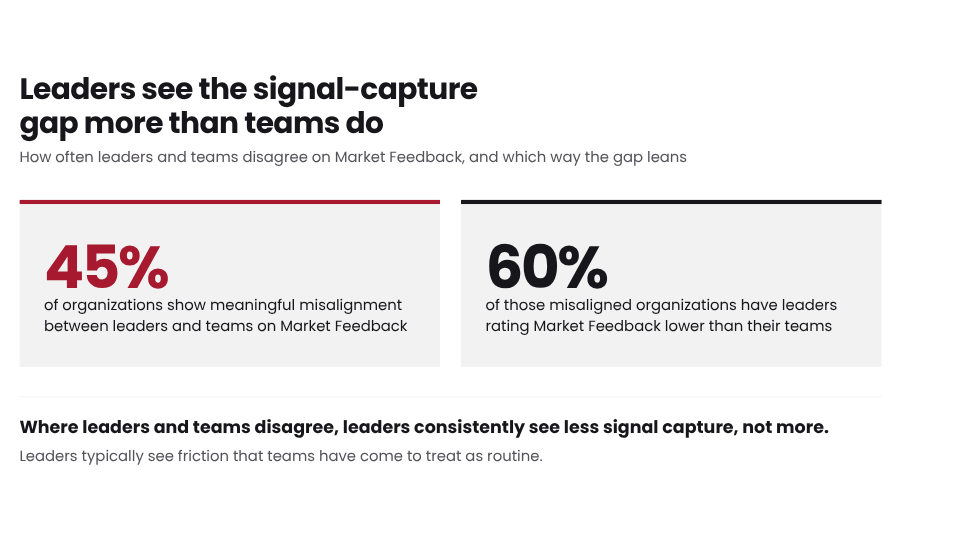
One possible explanation for the leader-team divide is that product-development teams are often separated from customers and receive feedback through second-hand channels such as surveys, sales teams, account teams, support channels, or product intermediaries. Teams may see that customer information is being collected, while leaders are evaluating whether it reaches product teams with sufficient context and meaningfully changes priorities.
What Do the Findings Tell Us Overall?
These findings reveal an important distinction: responding to known customer needs is not the same as building the feedback systems required to detect change and shape what gets built next.
Organizations appear equipped to respond when customer needs are already known. Yet, the Market Feedback findings reveal a more consequential gap: many organizations lack a systematic way to uncover what customers will need next and translate that evidence into priorities. Weak feedback-to-priority loops increase the risk of funding work that does not address emerging needs, responding late to market shifts, and scaling solutions based on internal assumptions rather than current customer evidence.
So why does market feedback lag when customer-facing performance is otherwise so strong? Three recurring patterns offer an explanation: signals are filtered through internal proxies, shaped by the loudest voices rather than the broader market, and lost across organizational silos.
What Patterns Emerge Across Organizations?
Across the organizations in our data set, three patterns emerge that explain why organizations struggle to capture customer signals effectively.
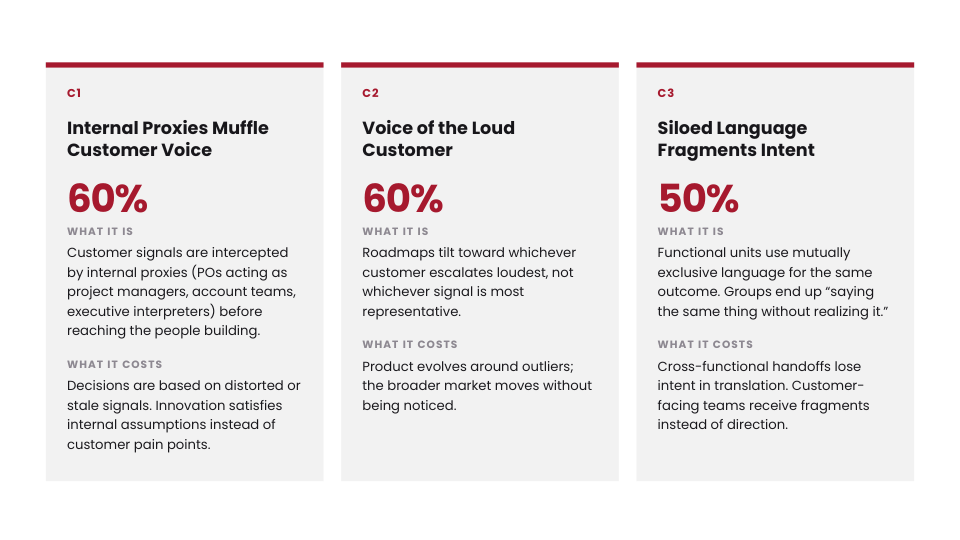
Internal Proxies Muffle the Customer's Voice
This pattern appears in 60 percent of organizations. Customer signals are intercepted by internal proxies, including product owners acting as project managers, account teams, and executive interpreters, before they reach the people building the product.
As those signals move through the organization, they can become distorted, delayed, or disconnected from their original context. Decisions are then based on those distorted or stale signals, and innovation satisfies internal assumptions instead of customer pain points.
This may be another explanation for the leader-team divide. Product-development teams may receive customer information through product owners, sales teams, account teams, surveys, or other intermediaries rather than through direct customer contact. Leaders may therefore see broader gaps in how customer signals are captured, interpreted, and translated into product decisions.
Rather than incorporating direct customer and market feedback, internal translations and organizational biases inform product design and solution development.
The Loudest Customer Shapes the Roadmap
The Voice of the Loud Customer pattern also appears in 60 percent of organizations. Roadmaps tilt toward the customer who escalates the loudest rather than the signal that is most representative of the broader market, so the product evolves around outliers while the broader market moves without being heard. In this pattern, the squeakiest wheel shapes organizational priorities.
Silos Disrupt Customer Learning
The third pattern reflects a familiar organizational challenge: silos.
Functional groups use different language to describe the same outcome, often saying essentially the same thing without realizing it, and cross-functional handoffs lose intent in translation.
As customer signals move through the organization, they can become distorted, delayed, or disconnected from their original context.
In Customer Centricity, the breakdown often occurs between receiving a customer signal and translating it into decisions and action.
What Separates Organizations with Stronger and Weaker Customer Centricity Scores?
For this analysis, organizations were grouped into the top and bottom quartiles based on their Customer Centricity dimension scores, rather than their overall Agile Health Assessment performance. The clearest distinction between organizations in the top and bottom quartiles of this dimension is not how much they say they value customers. It is whether they have established ways of working that consistently turn customer and market signals into product decisions and prioritized work.
Organizations in the top quartile describe repeatable feedback loops:
- "Customer signal goes straight to the backlog."
- "We ship to learn."
- "The Product Owner owns the voice of the customer."
These statements reflect customer learning built into the way work gets done: frequent, lightweight customer contact; backlog items tied directly to customer or market signals; hypotheses tested through small releases; and negative feedback treated as data to learn from.
Organizations in the bottom quartile describe something different: opinions, proxies, and isolated activities.
- "The CEO has a strong view."
- "We surveyed once last year."
- "Sales tells us what customers want."
Here, customer understanding depends more heavily on who is interpreting the signal. Feedback may be collected without changing priorities, internal conviction can outweigh market evidence, and negative feedback becomes something to manage rather than information that shapes what happens next.
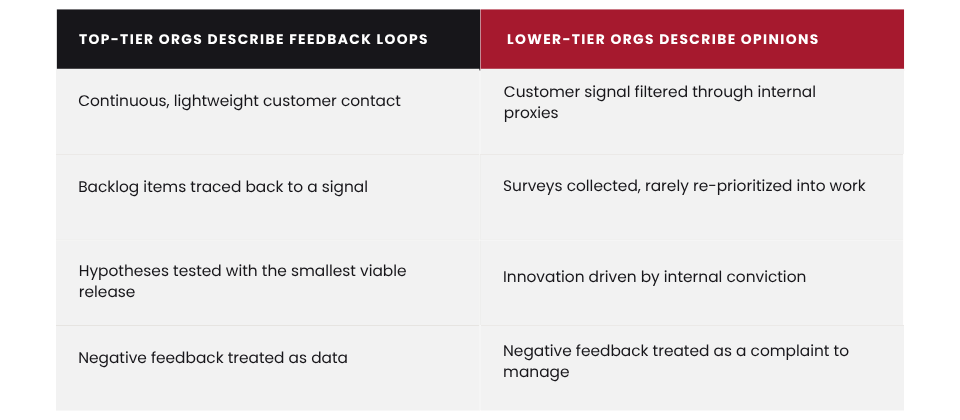
The difference is not whether organizations care about customers. It is whether customer learning has a reliable path into the work. Higher-scoring organizations close the loop between signal, decision, and action. Organizations in the bottom quartile are more likely to break that loop along the way. The implication is simple: customer evidence creates little value unless it changes priorities, decisions, and what gets built.
What Does This Mean for Leadership?
Three implications emerge from these findings:
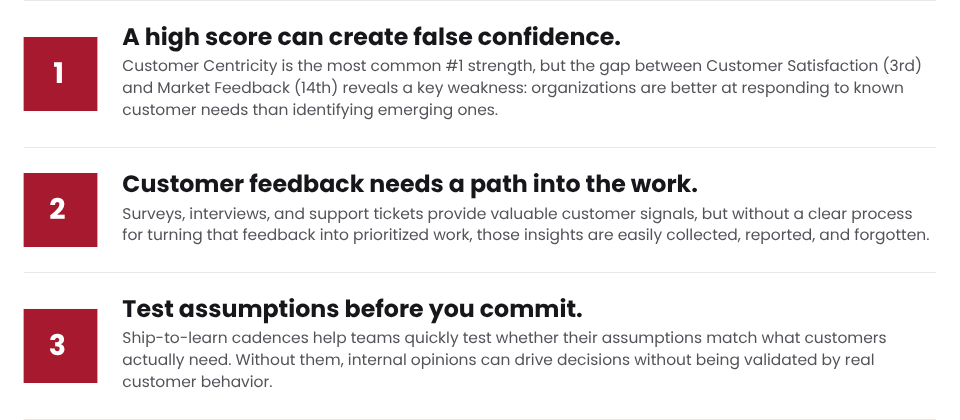
First, don't let strong Customer Centricity scores create false confidence. Customer Centricity is the most common #1 strength, but the gap between Customer Satisfaction (ranked 3rd) and Market Feedback (ranked 14th) reveals an important blind spot. Organizations are good at responding to customer needs they already understand. Leaders should be asking whether their teams are equally equipped to detect and act on needs as they emerge.
Second, make sure customer feedback has a path into prioritized work. Surveys, interviews, support tickets, and market observations only create value when they influence decisions. Leaders should look beyond whether feedback is being collected and ask what happens next: Who synthesizes it? How does it affect priorities? When does a customer signal actually change the backlog? Without that pathway, Voice of the Customer becomes reporting rather than a mechanism for learning.
Third, create the conditions to test assumptions quickly. Customer feedback still has to be interpreted, and every interpretation carries assumptions. Leaders can reduce the risk of internal conviction becoming "customer truth" by enabling teams to test those assumptions through small releases and ship-to-learn cadences. The goal is not to eliminate strong opinions. It is to create a system where evidence can challenge them before too much time and investment are committed.
For leaders, the takeaway is not simply to listen to customers more. It is to build an organization where customer signals can reach the work, challenge assumptions, and change direction while there is still time to act.
Summary
Customer Centricity is the most frequently reported #1 strength across our sample, with 52 percent of organizations ranking it first. Organizations perform well when customers clearly express their needs and those needs can be translated into action.
But the same data reveal where that strength begins to break down. Organizations are much less effective at capturing and acting on the customer and market signals that are never stated outright. Three recurring patterns help explain why: customer signals are filtered through internal proxies, shaped by the loudest voices instead of the broader market, and lost across organizational silos.
Leading organizations don't succeed simply because they're closer to their customers. They build repeatable systems that turn customer and market signals into prioritized work. In other words, the challenge isn't responding to customers. It's learning from them early enough to change what gets built. The ability to consistently translate those signals into action is what enables organizations to create value as customer needs evolve.