
ENTERPRISE CONSULTING

Agile Operating Models That Enable Execution

We help leaders align strategy, prioritization, and delivery so teams can execute at scale.

WHY AGILE STALLS

Teams Are Agile. The System Is Not.

Most organizations do not lack commitment or capability. Teams are trained, leaders are engaged, and Agile practices are in place. However, as work scales, execution slows, decision-making becomes cumbersome, priorities lose alignment, dependencies increase, and outcomes fall behind effort. The problem is not Agile at the team level, but the system that coordinates work across the organization.

In many organizations, Agile is layered onto operating models built for stability and control. Strategy sits far from delivery. Prioritization happens in batches. Governance adds friction instead of flow. Teams adapt locally while the broader system resists change. Execution problems at scale are not performance problems. They are design problems.

The Agile Operating Model

The Engine Behind High Performing Enterprises

An Agile Operating Model defines how strategy becomes delivery across the enterprise. It aligns decision making, prioritization, team structures, and feedback loops so work can move with speed and clarity as complexity increases. This is not a framework or an org chart. It is the system that determines how value flows, where decisions are made, and how quickly organizations can adapt. A well-designed Agile Operating Model connects three critical elements:
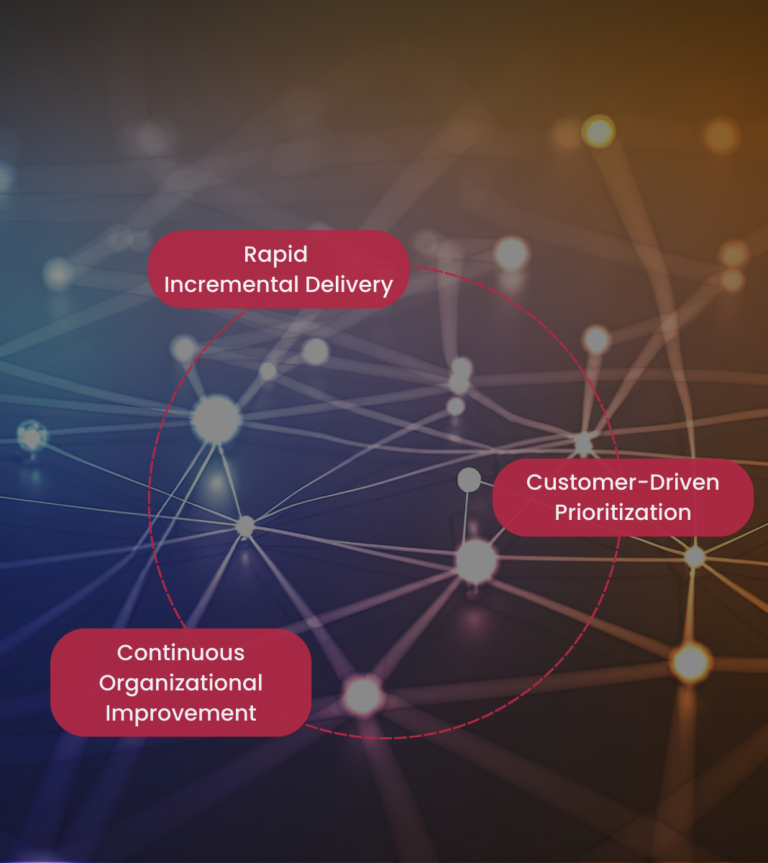
Strategy to Delivery Alignment: Ensures strategic priorities translate directly into team level work without delay, reinterpretation, or competing signals.
Decision Flow and Governance: Clarifies who decides what, at what level, and how quickly, reducing friction while maintaining appropriate control.
Learning and Adapting Loops: Creates rapid feedback between customers, teams, and leaders so the organization can adjust direction based on real outcomes.

The Scrum Inc. Approach

How Scrum Inc. Designs Agile Operating Models

Scrum Inc. helps redesign how work flows through the enterprise. We focus on the operating model, removing the constraints that slow delivery while the business continues to run. Our work connects strategy to prioritization, decision making, and delivery so teams can learn and adapt in real time. Change is delivered through execution and measurable results. Our operating models follow three practical approaches:
Make the System Visible
Most execution problems are hidden in plain sight. Strategy, priorities, and delivery are disconnected across layers of the organization. We help leaders see where decisions stall, where work queues up, and where effort is lost before it reaches customers.

Clarity comes from understanding the system as it operates today, not how it is supposed to work on paper.
Fix Decision and Priority Flow
Execution improves when decision making matches the pace of the work. We help organizations clarify who decides what, at what level, and on what cadence so priorities do not compete and teams are not blocked waiting for approval.

The result is faster alignment, fewer handoffs, and work that moves forward without constant escalation.
Improve Delivery While Running the Business
Operating models cannot be redesigned in isolation. We work inside the system as it runs, improving delivery, learning, and coordination without stopping the business.

Progress is visible, incremental, and measurable. Teams deliver sooner, leaders learn faster, and improvements compound over time.

Start with a Conversation.

Talk with a Scrum Inc. expert about how work actually flows through your organization. We will help you identify where execution slows, where decisions get stuck, and what to address first.
Talk to an Expert

Where to Start

Different organizations enter operating model work from different places. Most start by making the system visible and identifying the constraints that matter most right now.
Discovery and Assessment
Understand how work actually flows today. We observe decision making, prioritization, delivery paths, and handoffs across the enterprise. This creates a shared view of the system as it is, not as it is assumed to be, and surfaces the constraints slowing execution.
Operating Model Alignment
Once constraints are visible, leaders align on what must change at the system level. This includes decision rights, prioritization mechanisms, governance touchpoints, and team interfaces so strategy can translate into delivery without friction.
Transformation Roadmap Building
Change begins while the business continues to run. Leaders test improvements through real work, establish faster feedback loops, and build momentum through visible progress. The operating model evolves through learning, not reorganization.